
From scattered
data.To decisions you can trust.
One governed platform for ingestion, transformation, ML, APIs, and operations, so your AI starts on a single trusted source. One contract, one upgrade path, and no stack to stitch together first.
- Connects to the stack you already run
- Ingest, model, serve, and build agents on the same data
- Nothing has to be replaced on day one
SOC 2 Type II · ISO 27001 · GDPR assessed
Examined by Accorp Partners, QRO Certification and Scrut.
10+ enterprises in production
Air-gapped, on-premises, or in your own cloud.
2,000+ connectors, 40 copilots, 15 modules
Seventy executable compliance controls. All of it on one contract.
Start with the decision you are trying to make.
Four questions we hear in almost every first conversation. Each one leads to the part of the platform that answers it, so you can start where the pressure actually is.
Which numbers can we trust?
Reporting built on shared definitions your team owns, so two teams asking the same question get the same answer.
AnalyticsTrusted dataWhere is the data we need?
Find any asset in business language, see who owns it, and follow where it came from and what it feeds.
Data CatalogBusiness planningWhat should we plan for next?
Demand, capacity and cash explored against your own history, with the uncertainty shown alongside the forecast.
ForecasterAI and automationHow can AI help us act?
Answers and agreed actions inside the permissions of the person asking, with every action written down.
Agent StudioYour stack grew one sensible purchase at a time.
Every tool solved its own problem and handed you a new one: the seam between it and the next. You own every join.
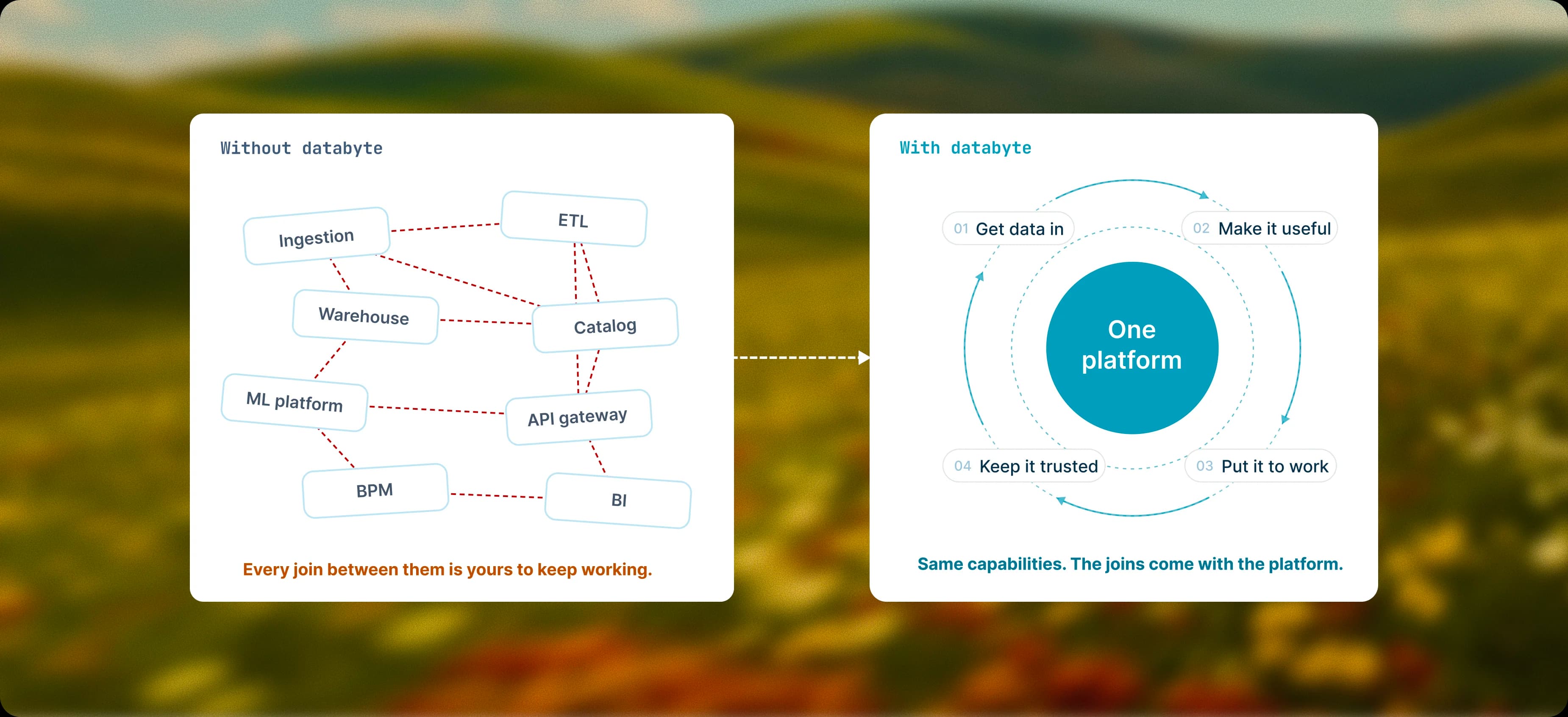
Every module is production-grade on its own. Together they share one data model, one catalogue, one security model and one operational surface.

Data Ingester
Move data in at any cadence: scheduled batch, on demand, or change data capture that streams every insert and update as it happens.
- Batch
- CDC
- Advance ETL

Integration Connector
Connect any two systems without a custom project. Build the flow on a visual canvas, test it before it goes live, and run it with approvals attached.
- Visual flows
- Open standard
- Governed

Transformer
Build transformation pipelines on a visual canvas or in a notebook, whichever suits the person doing the work. One engine for batch, streaming, and on demand.
- Visual canvas
- Spark
- Streaming

ML Studio
Take a model from data preparation to production in one place. AutoML and experiment tracking, one-click deployment as a versioned API, drift monitoring after go-live.
- AutoML
- Drift
- REST

Agent Studio
Build conversational and autonomous agents against the governed model rather than an export of it. Every agent answers inside the permissions of the person asking.
- Conversational
- Autonomous
- Governed

Forecaster
Forecast demand, capacity, or cash with 25+ time-series algorithms. Scheduled runs, accuracy dashboards, and side-by-side backtests, so you can see which model to trust.
- Time-series
- Backtesting
- Scheduled

Anomaly Detector
Catch the problem while it is still small. Continuous learning on live SQL, Kafka, webhook, and API streams, with alerts that carry the data that triggered them.
- Near-real-time
- Kafka
- Self-learning

Sherlock
Root cause analysis that runs itself. No-code decision trees isolate the failing component, trigger the fix, and verify recovery before the incident is closed.
- Root cause
- Auto-remediation
- No-code
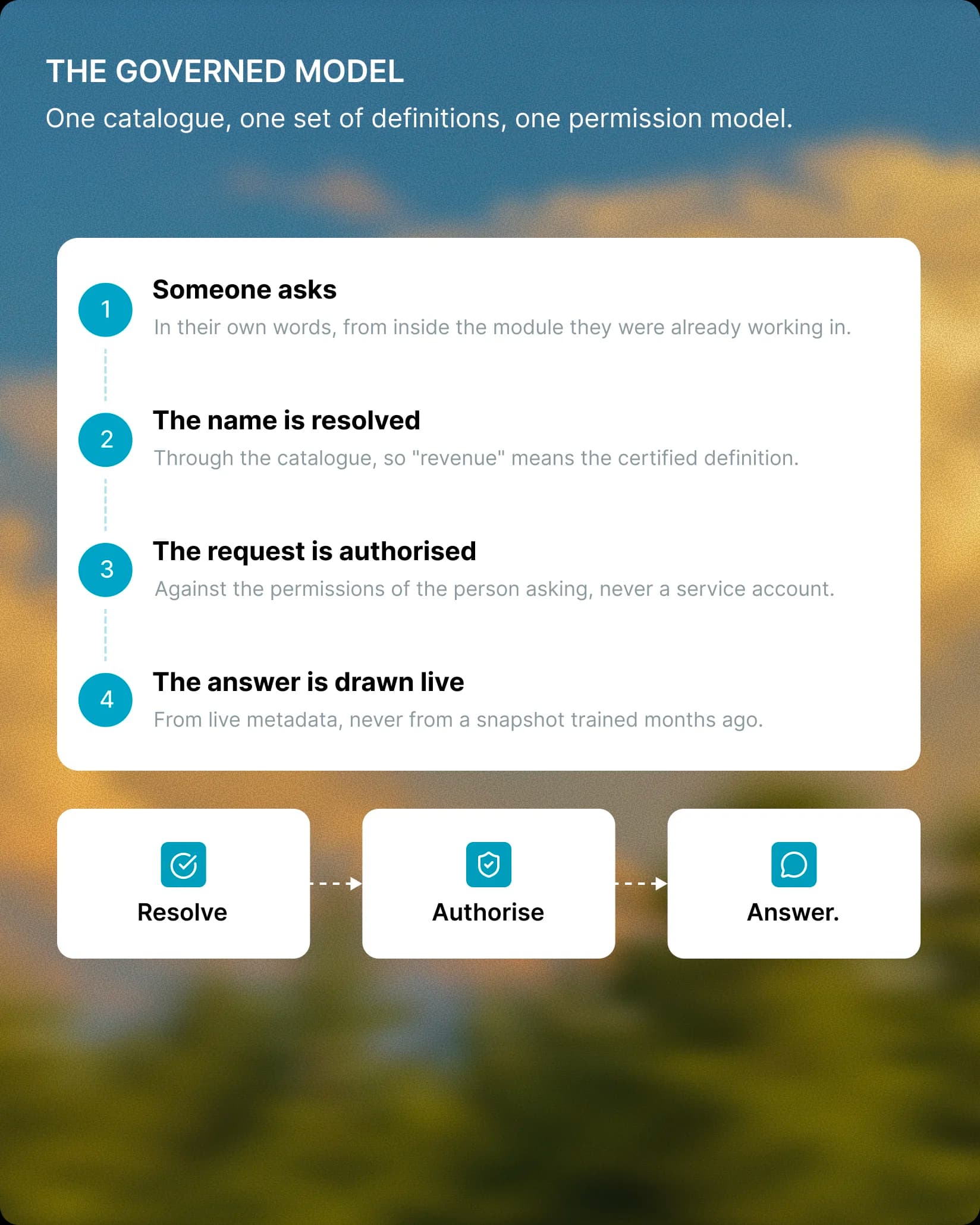
Copilots and agents here read the governed model itself, never an export of it, answer inside the permissions of the person asking, and run on models hosted on your own infrastructure.
40 copilots included
One on every stage of the platform, each reading live metadata as it stands now.
Agent Studio
Build conversational and autonomous agents of your own against the same governed model the copilots use.
Inside the asker’s permissions
An agent answers within the permission model of the person asking, not a service account with its own reach.
Agent operations
Telemetry, versioned prompts and release control for every agent you run, so a degraded agent is visible before someone complains.
Forecast and detect
Time-series forecasting, drift detection after go-live, and deviation on live streams as they arrive.
Diagnose and resolve
Sherlock traces an incident to its cause. Sentinel works on the failures nobody wrote a rule for.
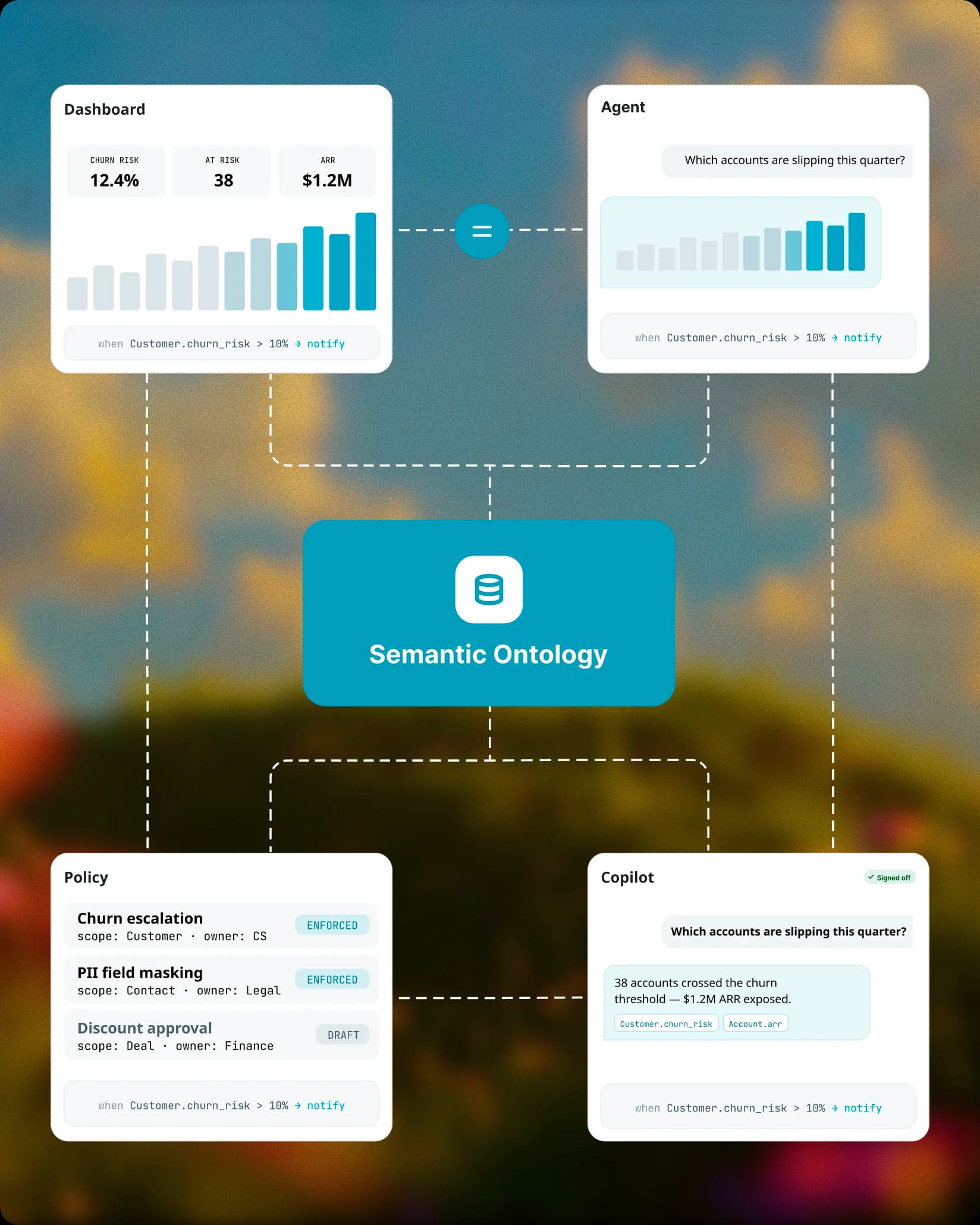
One versioned definition per business term, with an owner against it. That is why a dashboard and an agent return the same number.
Business objects your team already names
Orders, Customers and Network Elements become versioned definitions carrying their own relationships, APIs, lineage and policy.
One definition, everywhere
Dashboards, APIs and agents resolve the same name through the same catalogue, so two answers to one question agree.
Policy on the object
Access is evaluated against the business object a person is asking about, so the table underneath it never has to be named in a policy.
The reason the AI holds
Agents are grounded on these definitions. Without them an assistant is guessing confidently about tables it has never seen.
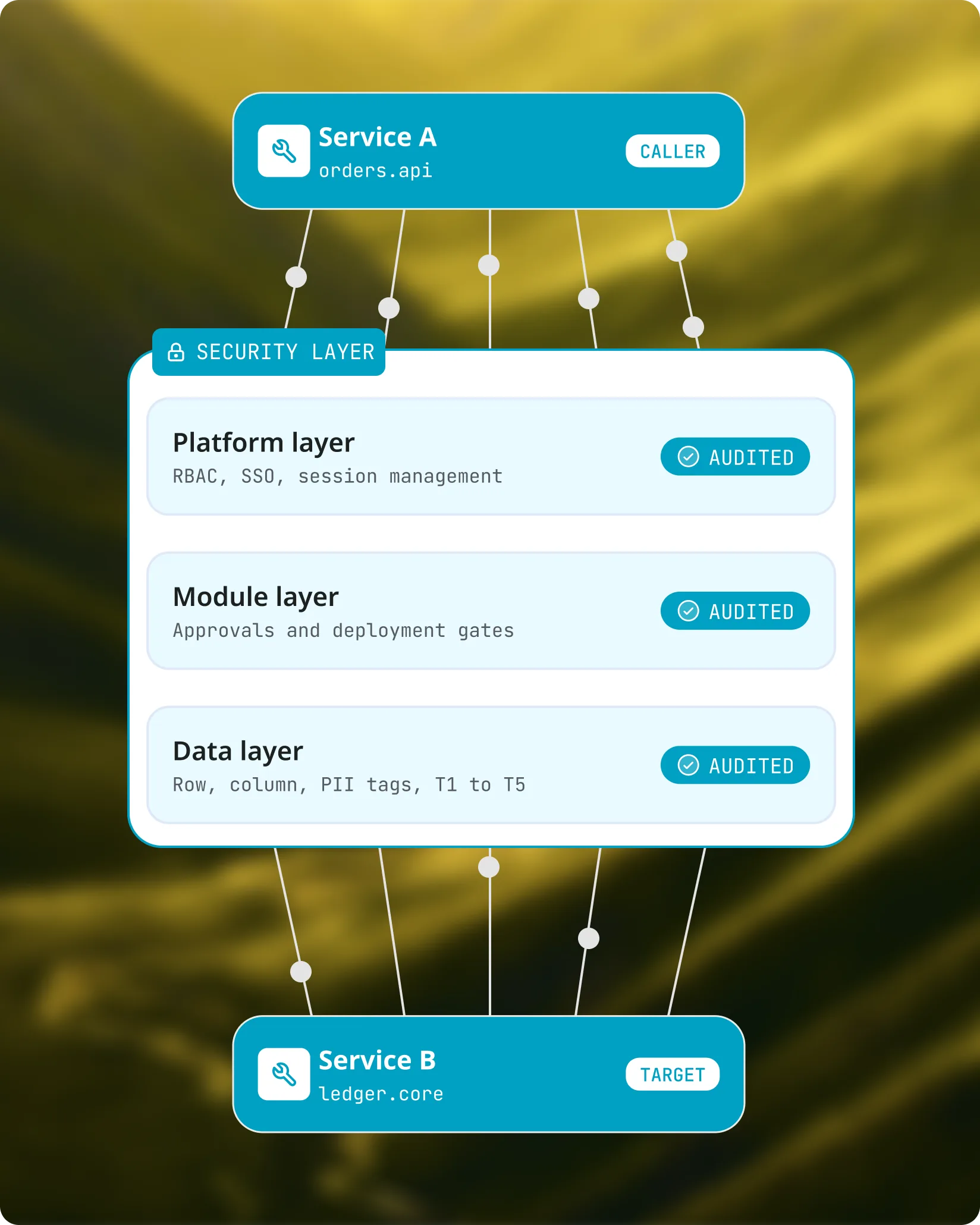
Every module inherits the same policy model, the same audit trail and the same catalogue. There is no hardening project between installation and production.
Three enforcement layers
Platform, module and data-level enforcement, evaluated in order, with no gap between them for a request to fall through.
Row and column level
Access narrows to the row and the column a person may see, not only to the table they may open.
A decision your team can point to
Open Policy Agent evaluates each request against the business object, so authorisation is reasoned at the moment of the request.
Encrypted in transit and at rest
Data is protected on the wire and on disk, under keys and a residency you choose.
One place to administer
Users, roles and permissions are managed once and apply to every module.
Independently assured
SOC 2 Type II, ISO 27001 and a GDPR control assessment, carried out by firms that do not work here. Report under NDA.
Built to run in production, on foundations your team knows.
The platform arrives with its security posture, its operational surface and its open foundations already in place, so the gap between installed and in production is measured in days.
Hardened on arrival
Seventy executable controls across sixteen domains, evaluated against what is running rather than what a policy document says should be.
Foundations your team already runs
Apache Spark, Kubernetes, Open Policy Agent and Apache Camel. Your platform engineers recognise all four on day one.
Operated, not just installed
Live pipeline health, SLA tracking and failure-pattern analysis ship with the platform, so scale is an operational question you can answer.
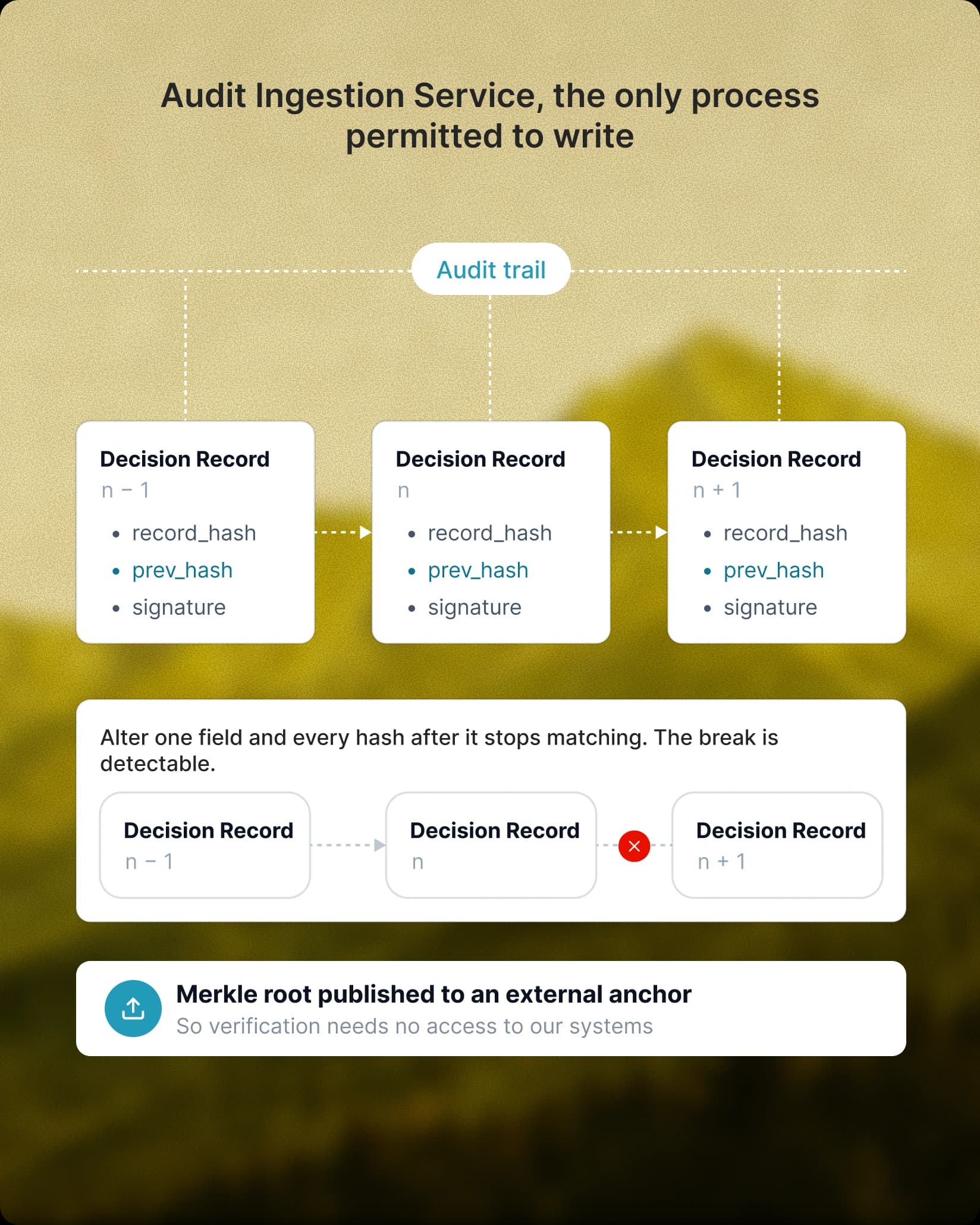
Because every module writes to one catalogue, one lineage graph and one audit trail, the evidence an auditor asks for is a query your team can run.
Chained audit trail
Every action is recorded with what authorised it, chained so any later alteration is detectable.
End-to-end lineage
Every asset and every hop, across modules that used to be separate products with separate lineage graphs.
Compliance as code
Seventy executable controls mapped to SOC 2, ISO 27001, GDPR, PCI DSS, SOX and the CIS Kubernetes Benchmark.
Classification on discovery
Sensitive fields are tagged as assets are found, so a GDPR question starts from metadata the platform already holds.
One catalogue
One inventory of every asset and its lineage, so no spreadsheet has to reconcile a catalogue per tool.
SMART in every module
SLAs, monitoring, actions, rules and traceability, uniform across the platform, in every module, on day one.
Which one applies to you is a procurement and regulatory question rather than a technical one, and it is settled before anything is installed.
Your cloud
AWS, Azure or GCP, in your own account and your own VPC, on Kubernetes your team already knows how to run.
Your region
US, EU or APAC. Data stays in the chosen region unless an explicit export action moves it, and that action is written to the audit trail.
On-premises
Your own data centre, your own hardware, your own network boundary, with the same platform and the same release train.
Fully air-gapped
No route to the public internet at all. The platform, the modules and the models all run inside the perimeter.
No vendor lock-in. Keep your choices open.
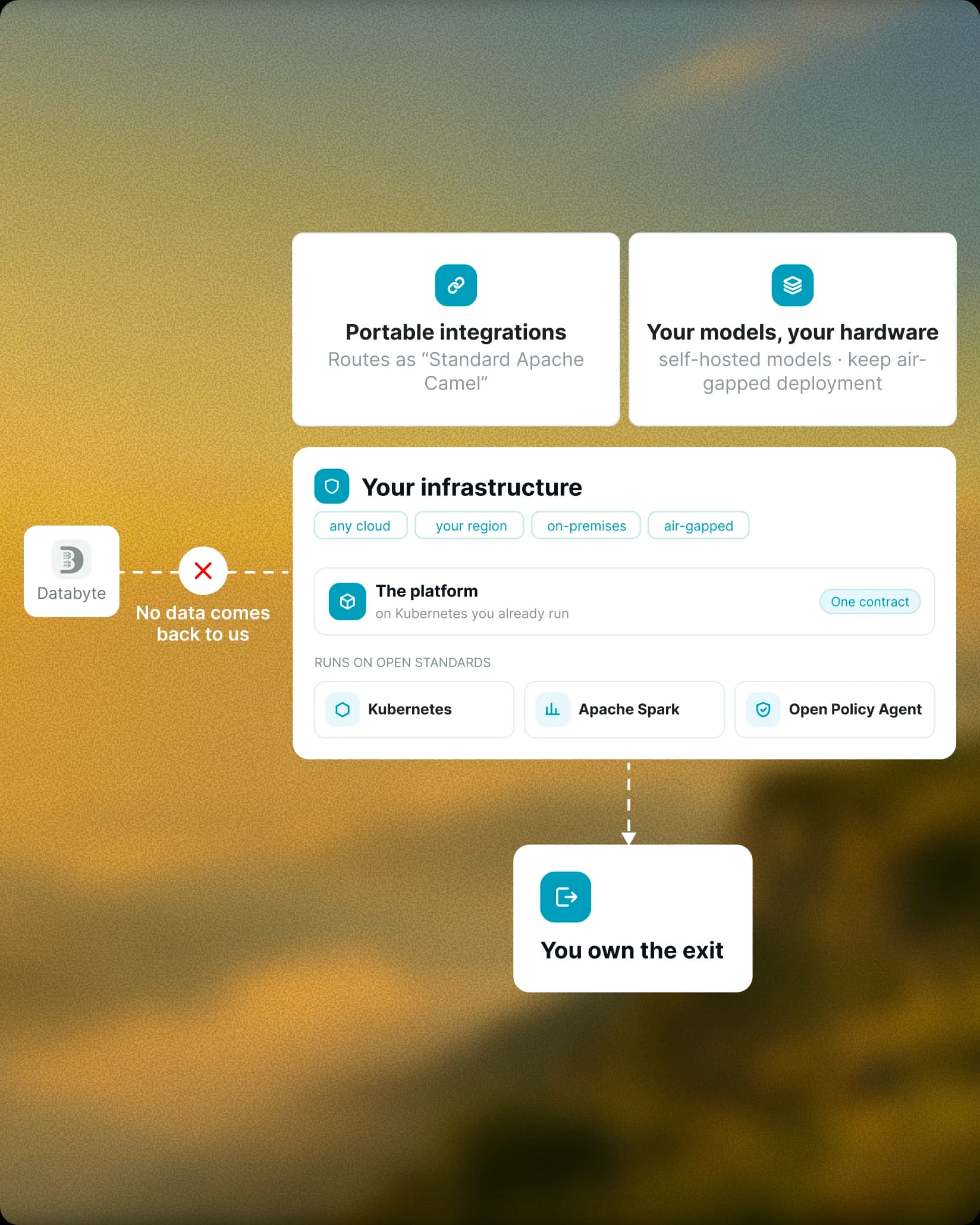
The platform runs on infrastructure you control, on standards your team already operates, under one agreement. Leaving is an engineering exercise with no negotiation attached.
Runs inside your walls
Any cloud, your own region, on-premises, or fully air-gapped, on Kubernetes you already know how to run.
Stays inside your boundary
The platform keeps working on your infrastructure alone. Your data stays where you put it, and so does the dependency.
Open standards underneath
Apache Spark, Kubernetes and Open Policy Agent. No proprietary runtime only one company knows how to operate.
Portable integrations
Integration routes are standard Apache Camel YAML, so what your team builds stays readable outside the platform.
One contract
Connectors, modules and copilots come with the platform, on one licence.
Your models, your hardware
Self-hosted models keep an air-gapped deployment air-gapped on the day you add AI to it.
Start with one seam. Keep everything else.
DataByte connects to the stack you already run. It closes the seams first, then takes over the pieces you choose to hand it, at whatever pace your contracts and your people allow.
Connect what you have
Two thousand connectors reach the systems you already run. Nothing is decommissioned, and nothing has to move.
You get one catalogue and one lineage graph across tools that never spoke to each other.
Run both and compare
Publish the same numbers from the old estate and the new one for a full reporting cycle. Sign off on the variance before anything is switched over.
The parallel run is the proof, not the risk.
Retire on your schedule
Tools come out when their contracts end and their workloads have somewhere to go.
One renewal at a time, in the order that suits your budget.
Some customers stop after the first step and keep everything they own. That is a supported outcome, not a failed sale.
Where you sit decides what this is worth.
What DataByte replaces depends on the chair. Each of these goes to the argument written for that seat.




Consolidate the stack without a two-year migration, on infrastructure you already run.
CIO / CTO
See the platform2,000+ connectors, and none of them billed separately.
Databases, warehouses, cloud storage, streaming, SaaS, BI and file formats. Drag-and-drop by default, custom code when a source demands it, and the same governance on every one of them.
280+ SaaS connectors
Read and written the same way, so permissions and lineage carry across every one.
 DatabasesPostgreSQL
 DatabasesMySQL
 DatabasesOracle
 DatabasesSQL Server
 DatabasesSnowflake
 DatabasesBigQuery
 DatabasesRedshift
 DatabasesMongoDB
 DatabasesCassandra
 Cloud storageAWS S3
 Cloud storageAzure Blob
 Cloud storageGCSCloud storageAzure Data Lake
 Cloud storageHDFS
 Cloud storageMinIO
 StreamingApache Kafka
 StreamingAWS KinesisStreamingAzure Event Hubs
 StreamingRabbitMQ
 StreamingWebhooks
 StreamingREST APIs
 SaaS appsSalesforce
 SaaS appsSAP
 SaaS appsServiceNow
 SaaS appsWorkday
 SaaS appsHubSpot
 SaaS appsZendesk
 SaaS appsJira
 BI and reportingPower BI
 BI and reportingTableau
 BI and reportingLooker
 BI and reportingExcel
 BI and reportingSFTP export
 BI and reportingEmail deliveryFile formatsCSV / JSON / XMLFile formatsParquetFile formatsAvroFile formatsORCFile formatsFTP / SFTP
See it running on your stack.
Thirty-minute walkthrough. Your data, your connectors, real pipelines. No slideware.